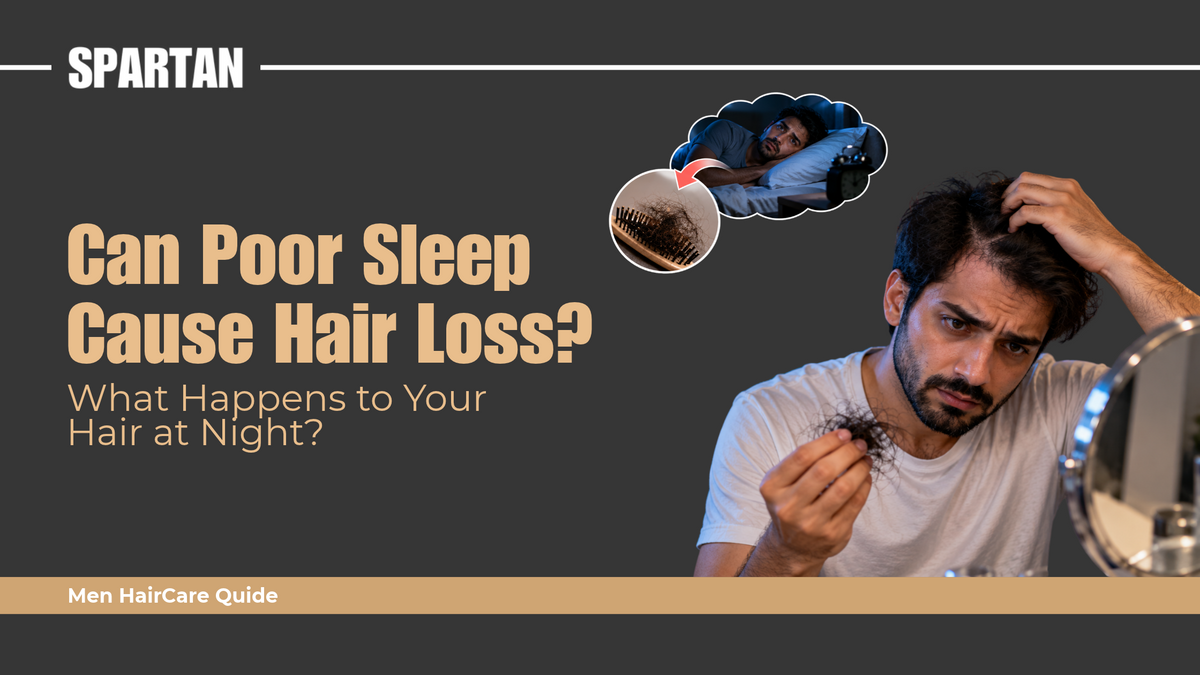
If you're sleeping only a few hours a night, waking up tired, or dealing with ongoing sleep disruption, you may wonder whether poor sleep is contributing to hair thinning.
The relationship between sleep and hair health is more complicated than simply saying that sleeping less makes you bald. Poor sleep can affect your overall health, stress response, and daily habits. Stress and certain health conditions can contribute to hair shedding, but there is no strong evidence that a few nights of poor sleep directly cause permanent male pattern baldness.
Understanding what happens to your hair at night—and how sleep may influence the hair-growth cycle—can help you build a more effective hair-care routine.
Quick Answer
Poor sleep may contribute to hair shedding indirectly by affecting stress regulation, overall health, and behaviors that support normal hair growth. However, sleep deprivation alone is not an established direct cause of male pattern baldness. Hair loss can also result from genetics, hormonal sensitivity to DHT, nutritional deficiencies, illness, and scalp conditions. Improving sleep is beneficial for overall health, but it should not be considered a standalone treatment for progressive hair loss.
What Happens to Your Hair While You Sleep?
Your hair doesn't stop growing when you go to bed.
Hair follicles move through a repeating growth cycle that includes active growth, transition, rest, and shedding. Biological signals, hormones, genetics, and other factors regulate these stages.
Sleep is an important part of your body's daily biological rhythm, but hair growth is not simply switched on during the night.
The Hair Growth Cycle
Hair follicles typically move through four stages:
- Anagen (growth): The follicle actively produces a hair strand. This phase can last several years.
- Catagen (transition): Growth slows, and the follicle begins to shrink.
- Telogen (rest): The follicle remains relatively inactive before the hair is released.
- Exogen (shedding): The old hair sheds, allowing the cycle to continue.
At any given time, different follicles are in different stages.
This explains why you may notice hair on your pillow or in the shower without necessarily experiencing abnormal hair loss.
Normal shedding is part of the hair cycle. The concern is when shedding becomes excessive, persistent, or accompanied by visible thinning.

Can Poor Sleep Cause Hair Loss?
The relationship between poor sleep and hair loss is still being studied.
Sleep deprivation can affect several systems involved in overall health, including stress regulation, metabolism, and immune function. These effects may indirectly influence hair health.
However, it is important to distinguish between a possible contributing factor and a confirmed cause.
Poor sleep is not considered an established direct cause of androgenetic alopecia, or male pattern hair loss.
Male pattern hair loss is primarily associated with genetic susceptibility and the effects of DHT on particular hair follicles.
Poor sleep may coexist with hair loss, contribute to stress, or make existing concerns feel more noticeable. But it should not automatically be blamed for a receding hairline or thinning crown.
1. Poor Sleep Can Increase Stress
One possible connection between sleep and hair shedding is stress.
When you consistently sleep poorly, you may feel more anxious, irritable, or overwhelmed. Chronic stress can affect your overall health and may contribute to certain types of hair shedding.
One example is telogen effluvium.
This condition occurs when an unusually large number of hair follicles shift into the resting phase of the hair-growth cycle.
The result can be increased shedding several months after a triggering event.
Potential triggers include:
- Significant emotional stress
- Major illness
- Surgery
- High fever
- Rapid weight loss
- Certain medications
- Major dietary changes
Poor sleep may be one part of a broader stress pattern, but it is not necessarily the sole trigger.
Does Stress-Related Hair Loss Grow Back?
In many cases, temporary stress-related shedding improves once the underlying trigger resolves.
However, hair recovery takes time.
Even after shedding begins to settle, it may take several months for new hairs to become long enough to improve visible coverage.
If your hair loss is persistent or progressive, don't assume stress is the only explanation.
2. Sleep and Your Hormonal System
Your body follows a circadian rhythm, a roughly 24-hour biological cycle that influences sleep, hormone secretion, body temperature, and other physiological processes.
Sleep disruption can affect this rhythm.
However, the relationship between sleep, hormones, and hair loss is not straightforward.
Does Poor Sleep Increase DHT?
DHT, or dihydrotestosterone, is a hormone involved in male pattern hair loss.
In genetically susceptible follicles, DHT contributes to miniaturization. Over time, affected hairs may become finer and shorter.
But poor sleep does not automatically mean that your DHT levels are elevated or that your hair follicles are becoming more sensitive to DHT.
A receding hairline is not proof that you have a sleep-related hormonal problem.
If you're noticing progressive thinning around the temples or crown, male pattern hair loss is one possible explanation and should be evaluated separately from your sleep habits.
3. Sleep and the Body's Recovery Processes
Sleep supports several processes involved in normal health and recovery.
These include:
- Tissue maintenance
- Immune regulation
- Metabolic function
- Nervous system regulation
- Physical recovery
Hair follicles are metabolically active structures, but this does not mean that sleeping longer will automatically make your hair grow faster.
There is currently no reliable basis for promising that a specific bedtime, sleep position, or number of extra hours will reverse genetic hair loss.
The practical goal is to maintain healthy sleep habits while addressing any actual hair-loss condition.
4. Can Poor Sleep Affect Your Nutrition?
Sleep and eating habits can influence each other.
When sleep is consistently disrupted, some people experience changes in appetite, food choices, or meal timing.
If poor sleep contributes to irregular eating or inadequate nutrition, that may indirectly affect hair health.
Hair growth requires adequate nutritional support, including:
- Protein
- Iron
- Zinc
- Essential vitamins and minerals
- Sufficient overall energy intake
Severe dietary restriction or certain nutritional deficiencies can contribute to hair shedding.
However, poor sleep does not automatically cause a nutritional deficiency.
If you're experiencing hair loss alongside fatigue, dietary restriction, or unexplained changes in health, a healthcare professional can help determine whether nutritional assessment is appropriate.
5. Poor Sleep May Make Hair-Care Habits Worse
Sleep disruption can affect your daily routine.
When you're tired, you may be more likely to:
- Skip regular hair washing when needed
- Use excessive styling products
- Scratch an irritated scalp
- Rely on heavy products to hide flat hair
- Follow an inconsistent grooming routine
These behaviors do not necessarily cause permanent hair loss, but they can affect scalp comfort and the appearance of your hair.
For example, product buildup or scalp irritation may make your hair feel uncomfortable or look flatter.
A consistent routine can help you manage these issues without assuming that sleep deprivation is directly damaging your follicles.
Why Does My Hair Look Thinner After a Bad Night's Sleep?
Sometimes, the issue is not actual hair loss but how your hair looks after sleeping.
If you've had a restless night, your hair may be:
- Flattened against the scalp
- Compressed on one side
- Tangled
- Frizzy
- Difficult to style
- More visibly separated at the roots
These changes can make your hair appear thinner, especially if you already have fine hair or some degree of hair loss.
Can Sleeping on One Side Cause Hair Loss?
Sleeping on one side may create friction between your hair and pillow.
This can contribute to tangling or breakage, particularly if your hair is fragile, chemically treated, or already damaged.
However, ordinary sleeping positions are not an established cause of male pattern baldness.
If you notice hair breakage, consider reducing friction and avoiding aggressive brushing when you wake up.
Does Wet Hair on a Pillow Cause Hair Loss?
Wet hair is more vulnerable to mechanical damage than dry hair.
Going to bed with very wet hair may increase friction, tangling, and breakage in some circumstances.
It does not automatically cause permanent follicle loss.
If your hair is prone to breakage, consider allowing it to dry before sleeping and using gentle hair-care techniques.
How Much Sleep Do Men Need for Healthy Hair?
Most adults should aim for approximately 7–9 hours of sleep per night.
This recommendation supports general health and recovery. It is not a hair-regrowth prescription.
Sleeping for nine hours does not guarantee thicker hair, and sleeping poorly for a few nights does not automatically cause baldness.
The more useful goal is consistency.
Try to maintain a regular sleep and wake time, create a comfortable sleep environment, and address persistent sleep difficulties.
Can Improving Sleep Help Hair Grow Back?
Improving sleep may support your overall health and help reduce some factors associated with stress or poor recovery.
However, whether hair grows back depends on the cause of the thinning.
Cause of Hair Thinning |
Can Better Sleep Help? |
|
Temporary stress-related shedding |
May support overall recovery, but addressing the trigger is important |
|
Male pattern hair loss |
Sleep alone is not an established treatment |
|
Nutritional deficiency |
Sleep does not replace correcting the deficiency |
|
Hair breakage |
Sleep habits may help reduce friction-related damage |
|
Scalp inflammation |
Appropriate scalp treatment is needed |
|
Medication-related hair loss |
The medication and underlying cause need professional review |
If your hair is thinning because of male pattern hair loss, improving sleep should complement—not replace—appropriate treatment.
What About Hair Growth Shampoo for Men?
"Hair growth shampoo for men" is popular among men looking for ways to improve hair thickness.
A suitable shampoo can help remove oil, sweat, dirt, and styling residue. It may also improve the appearance and feel of your hair.
However, shampoo cannot compensate for chronic sleep deprivation, and it should not be expected to reverse every type of hair loss.
If your scalp is oily, choose a cleansing routine that suits your scalp. If your scalp is dry or sensitive, consider a gentler formula.
The right shampoo can support scalp care, but it is not a substitute for identifying the cause of thinning.
What Is the Best Hair Loss Shampoo for Men?
There is no single best hair loss shampoo for men that works for every cause of hair thinning.
The appropriate choice depends on your scalp and hair-care needs.
A shampoo may help with:
- Scalp cleanliness
- Excess oil
- Product buildup
- Dandruff
- Hair texture and appearance
But if you're experiencing progressive thinning around your temples or crown, the underlying issue may be androgenetic alopecia.
In that situation, a dermatologist can help determine whether established treatments such as minoxidil or finasteride are appropriate.
Does a DHT Blocking Shampoo Help With Hair Loss?
A DHT-blocking shampoo is marketed toward men concerned about male pattern hair loss.
DHT plays a role in androgenetic alopecia, but a shampoo should not be assumed to have the same effect as a medical treatment that reduces DHT.
The effectiveness of a product depends on its formulation and supporting evidence.
If your hair is thinning because of genetic sensitivity to DHT, relying exclusively on a shampoo is unlikely to provide the same benefit as an evidence-based treatment strategy.
Sleep improvement and scalp care can be useful parts of your routine, but they do not directly address the genetic mechanism of male pattern hair loss.
What About Rosemary Oil for Hair Growth Men?
Rosemary oil for hair growth men is another popular search term.
Rosemary oil is sometimes included in hair-care routines, but evidence supporting its ability to regrow hair is limited compared with established medical treatments.
If you choose to use a rosemary-based product, follow the manufacturer's directions.
Avoid applying concentrated essential oils directly to your scalp, as they can cause irritation or allergic reactions.
If your scalp is already itchy or inflamed, adding another product may make it harder to identify the cause.
Can Hair Loss Supplements Help If You Sleep Poorly?
Some men research men's sexual health supplements, testosterone boosters, or hair-growth supplements when they notice thinning.
However, supplements marketed for testosterone or sexual performance should not automatically be considered hair-loss treatments.
Poor sleep does not automatically indicate low testosterone, and hair loss alone cannot establish a hormonal deficiency.
Similarly, taking biotin, zinc, or other supplements without a demonstrated need is not a reliable way to reverse thinning.
If you're concerned about hormonal health, nutrition, or persistent hair loss, discuss those concerns with a healthcare professional rather than relying on supplements alone.
A Practical Nighttime Routine for Healthier Hair
A nighttime routine should focus on sleep quality, scalp comfort, and reducing unnecessary hair damage.
Before Bed
- Maintain a consistent bedtime.
- Avoid going to bed with heavy styling-product buildup.
- If your hair is wet, consider allowing it to dry before sleeping.
- Avoid aggressive brushing or scratching.
- Keep your scalp comfortable and avoid applying products that trigger irritation.
Improve Your Sleep Environment
Try to:
- Keep your bedroom dark and comfortable.
- Maintain a regular sleep schedule.
- Reduce stimulating activities close to bedtime.
- Avoid excessive caffeine late in the day.
- Create a relaxing wind-down routine.
These habits may support better sleep, although they are not guaranteed hair-regrowth methods.
In the Morning
If your hair looks flat or thinner after sleeping, avoid immediately assuming that you've lost hair overnight.
Check whether the difference is caused by:
- Hair direction
- Compression
- Oil
- Friction
- Styling
If you are monitoring actual hair loss, compare photographs taken under consistent conditions over several months.
When Should You Be Concerned About Hair Loss?
Poor sleep may be one factor in your overall health, but it should not distract you from other potential causes of thinning.
Consider seeing a dermatologist if you notice:
- A progressively receding hairline
- Increasing crown visibility
- Persistent excessive shedding
- Sudden or patchy hair loss
- Scalp pain, redness, or scaling
- Hair loss that continues despite improving your sleep
A dermatologist can help distinguish temporary shedding from male pattern hair loss and other scalp conditions.
Sudden or patchy hair loss, especially when accompanied by inflammation, should be evaluated rather than treated only with shampoo or supplements.
Myth vs. Fact
Myth: Sleeping less than eight hours automatically causes baldness.
Fact: Poor sleep is not an established direct cause of male pattern baldness. Hair loss has several possible causes, including genetics, DHT sensitivity, medical conditions, and temporary shedding.
Myth: Hair grows only while you sleep.
Fact: Hair follicles follow a continuous growth cycle. Sleep is important for overall health, but hair growth does not occur exclusively at night.
Myth: Sleeping longer will regrow a receding hairline.
Fact: Better sleep supports general health, but it is not a proven standalone treatment for genetic hair loss.
Myth: An itchy scalp means DHT is damaging your hair.
Fact: Itching may result from irritation, dandruff, allergies, or other scalp conditions. It does not automatically indicate DHT-related hair loss.
Myth: Hair growth shampoo can fix sleep-related hair loss.
Fact: Shampoo can support scalp care, but it cannot replace appropriate evaluation and treatment when hair loss has an underlying medical cause.
Best Solution Summary
If you're wondering whether poor sleep is causing your hair to thin, consider the bigger picture.
Sleep may influence your overall health and could contribute indirectly to factors associated with hair shedding. However, it is not an established direct cause of male pattern baldness.
Concern |
What to Focus On |
|
Poor sleep |
Build a consistent sleep routine |
|
Stress-related shedding |
Identify and address the trigger |
|
Receding hairline |
Assess for male pattern hair loss |
|
Crown thinning |
Track changes and consider professional evaluation |
|
Itchy scalp |
Identify irritation or an underlying scalp condition |
|
Hair breakage |
Reduce friction, heat, and mechanical damage |
For men building a hair-care routine, TrySPARTAN products may be incorporated into general grooming and scalp care. Choose products based on your scalp type and avoid treating cosmetic products as guaranteed hair-regrowth solutions.
Frequently Asked Questions
Can lack of sleep cause hair loss in men?
Poor sleep may contribute indirectly to factors associated with hair shedding, such as stress or disrupted health habits. However, it is not an established direct cause of male pattern baldness.
How many hours should men sleep for healthy hair?
Most adults should aim for approximately 7–9 hours of sleep per night. This supports general health, but it is not a guaranteed hair-growth formula.
Can hair grow back after sleep-related hair loss?
If hair shedding is related to a temporary trigger, it may improve once the trigger resolves. Recovery often takes several months. Persistent thinning should be evaluated to determine the actual cause.
Does sleeping late cause a receding hairline?
Sleeping late by itself is not an established cause of a receding hairline. Male pattern hair loss is primarily associated with genetic susceptibility and DHT sensitivity.
Can poor sleep increase DHT?
Sleep disruption can affect biological rhythms and hormone regulation, but it does not automatically mean that DHT levels are elevated or that hair follicles are becoming more sensitive to DHT.
Should I use hair growth shampoo if I have poor sleep?
A suitable shampoo can support scalp cleanliness and hair appearance. However, it will not compensate for poor sleep or treat every cause of hair loss.
Final Takeaway
Can poor sleep cause hair loss? It may contribute indirectly to factors associated with hair shedding, but the relationship is not as simple as sleeping less and becoming bald.
Your hair follicles follow a biological growth cycle. Temporary shedding, male pattern hair loss, nutritional deficiencies, scalp conditions, and hair breakage can all affect hair density—and each requires a different approach.
Prioritize consistent sleep, maintain a suitable hair-care routine, and avoid assuming that sleep deprivation is the only explanation for thinning.
If your hairline is progressively receding, your crown is becoming more visible, or shedding continues, identify the underlying cause rather than relying on sleep improvements or shampoo alone.